Core Resources provides a comprehensive range of mineralogy services to support metallurgical investigations, process development and geometallurgical studies.
From advanced analysis with the MinDet Emago to traditional optical microscopy, our Brisbane laboratory delivers the detailed mineralogical data needed to optimise processing performance and reduce project risk.
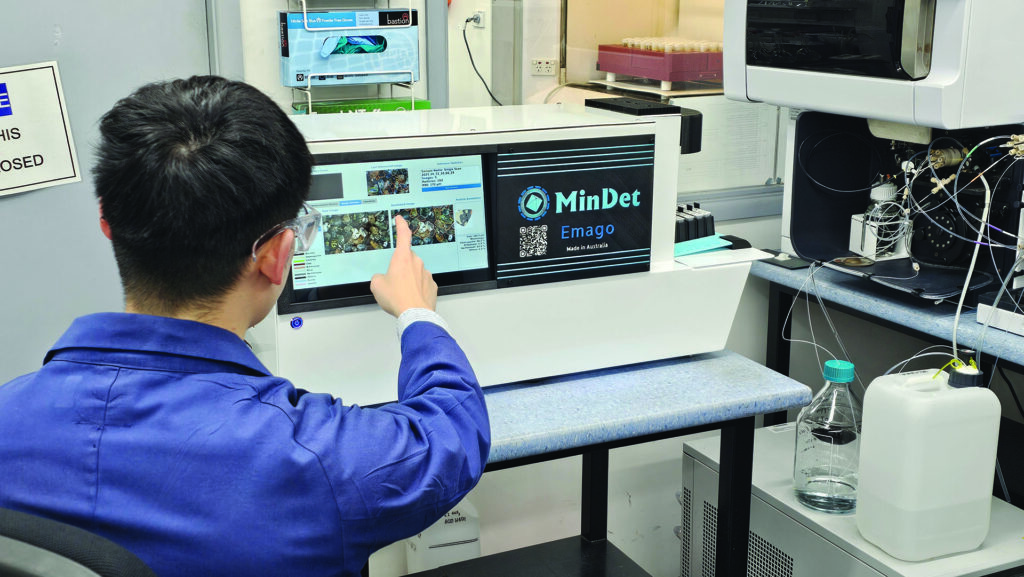
Core Resources offers advanced mineralogical analysis using the MinDet Emago, a laboratory-based system that delivers high-resolution insight from very small samples. This capability provides fast, quantitative data on mineral composition, liberation, elemental grade and particle size distribution (PSD).
The service supports a wide range of metallurgical investigations and geometallurgical studies, from diagnostic mineralogy and grind optimisation to variability testing and block model development. It also identifies non-target minerals such as clays, micas and gangue phases that may influence recovery and processing performance.
Learn more about this service on our MinDet Emago Mineralogy Testing page.
Optical microscopy of thin sections produced from rock chip or drill core samples can be used to provide insight into host rock mineralogy and the morphology of minerals that are of economic interest.
Much like automated electron microscopy analysis, this information can be valuable in determining optimum grind size and potential beneficiation pathways at the early stages of a project.
Samples of concentrate or tailings taken during testing can be mixed with epoxy resin and polished, allowing for closer inspection using reflected light microscopy of opaque minerals such as sulphides.
Such analysis can be valuable in identifying whether the loss of valuable metal to tailings is influenced by the size, shape, or liberation of target minerals. It therefore provides an additional layer of information that cannot be obtained through conventional chemical assay methods, which can be invaluable in identifying losses in flotation circuits or incomplete extraction in a hydrometallurgical leach process.